


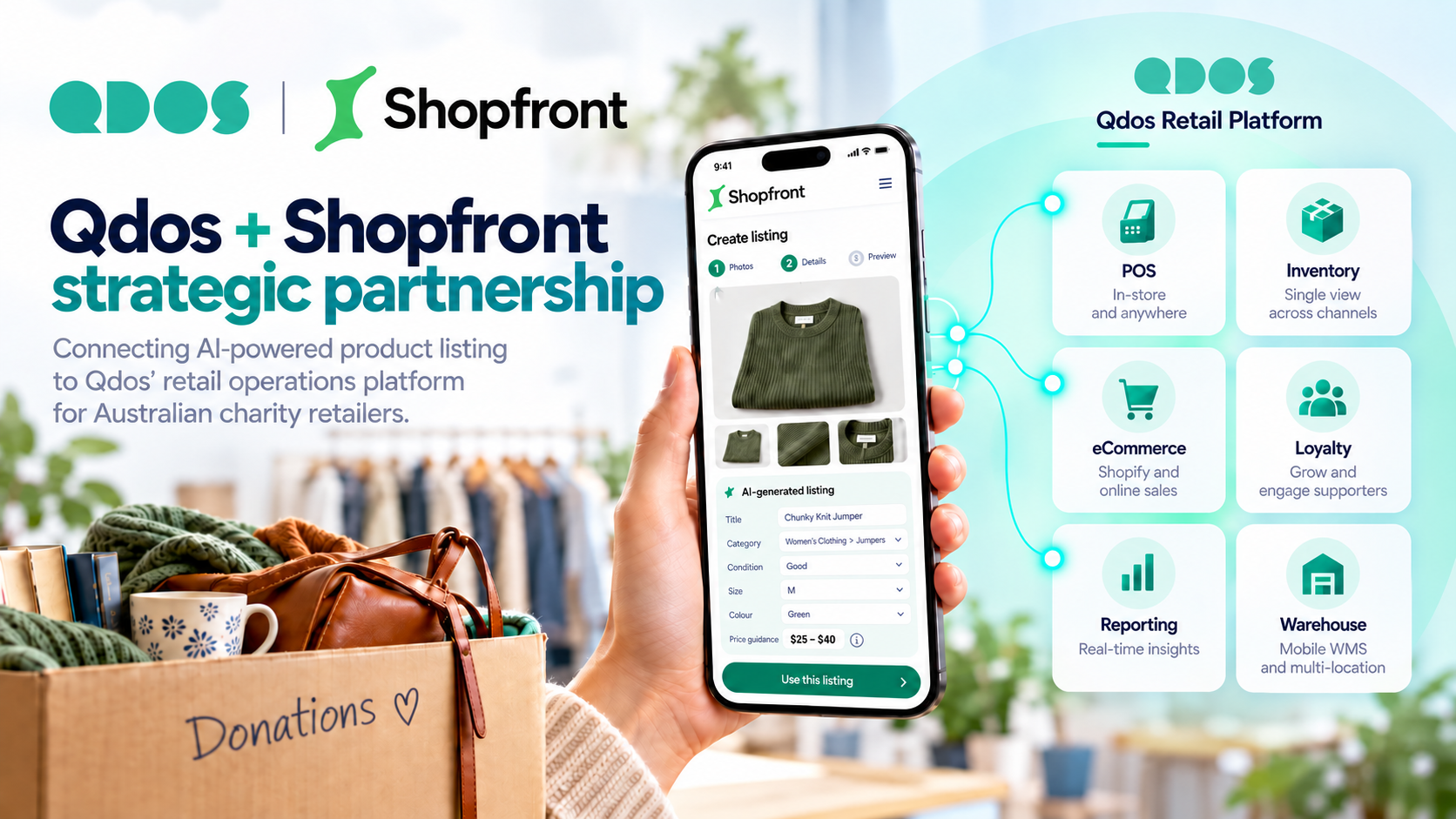
Qdos and Shopfront have partnered to connect AI-assisted product listing directly to the operational platform Australian charity retailers already run on.
The Qdos and Shopfront integration is an AI-assisted ecommerce listing workflow for Australian charity retailers and op shop networks. Shopfront turns photos of unique donated goods into structured product information. Qdos then creates the product, publishes it to Shopify and manages it within the charity’s wider retail operation on the Qdos charity retail platform.
Before a donated item can be sold online, someone usually needs to photograph it, identify it, describe it, categorise it, assess its condition, price it and set it up for ecommerce.
The bottleneck is the repeated manual work required to prepare large volumes of unique donated products for ecommerce.
Donation → Shopfront → Qdos → Shopify → Sale
The important part is what happens next. Because Shopfront sends the product into Qdos, it becomes part of the same inventory, ecommerce, fulfilment, loyalty, reporting and accounting processes the organisation already uses. The listing doesn’t become a separate ecommerce record that stores need to reconcile later.
Online and in-store aren’t separate worlds. Shoppers earn the same loyalty rewards wherever they buy, promotions can run across one channel or both, and online purchases can be returned at any store in the network, straight back on the rack for resale.





Shopfront makes getting each donated item online simple. Qdos makes it part of the wider retail operation.
The opportunity isn’t simply to create the same number of listings faster. It’s to make online selling practical for a larger share of suitable donated stock — giving more donated goods the chance to reach the customer most likely to value them, rather than relying only on foot traffic at the store where they were received.
Reduce the manual effort required to prepare unique products for ecommerce.
Create a more repeatable listing process across stores, staff and volunteers.
Online products are managed inside Qdos, not in a separate system that needs reconciling.
Give suitable donated goods access to customers beyond the store where they were received.
Want to see what this would look like in your own charity retail workflow? See the Qdos and Shopfront integration in action.
Qdos has worked with Australian charity retailers for more than 15 years, supporting some of Australia’s largest op shop networks with point of sale, donated inventory, warehouse operations, ecommerce, loyalty, reporting and accounting integration, across multi-store networks run by staff and volunteers. Learn more about the Qdos platform for charity stores.
Shopfront has built AI-assisted product listing tools specifically for the donated stock challenge, where each item is unique and conventional product catalogues don’t apply.
Together, they provide a connected pathway from donated item to live online listing, managed within the charity’s wider retail operation.
It connects Shopfront’s AI-assisted product listing to Qdos. Shopfront prepares the listing from a photo of a donated item, and Qdos creates the product, publishes it to Shopify and manages it within the charity’s wider retail operation.
Shopfront uses AI to help generate titles, descriptions, categories, condition assessments and pricing guidance from photos of unique donated and second-hand goods, reducing the manual work needed to prepare each item for online sale.
Qdos handles Shopify publishing, orders, fulfilment, loyalty, reporting and accounting integration, on the same platform that runs the charity’s point of sale, inventory and warehouse operations across every store.
Australian charity retailers and op shop networks that want to list more unique donated stock online while keeping ecommerce connected to their broader retail operation. The integration is available now for Australian charity retailers.
Attending the Charitable Reuse Australia Conference in Brisbane, 12–13 October 2026? Come and see how a donated item moves from photograph, through AI-assisted product creation, into Qdos and out to Shopify.
Not attending? We can show you the workflow and talk through how it could fit within your existing charity retail and ecommerce operation.
Book a Qdos + Shopfront walkthrough
Or contact Gavin at gavin@qdos.com.au